




This is the practical shop counter guide UK independent retailers need before committing to a purchase, covering the main counter types, what the price gap between budget and commercial-grade actually means, and how to size a retail till counter UK convenience stores operate at volume. If you are searching for a shop counter for sale, read this before you order.
The shop counter is the last thing most retailers think about when fitting out a new store and the first thing their customers interact with at the end of every visit. That mismatch explains why so many retail checkout areas underperform: functionally, visually and commercially.
A poorly chosen counter creates friction at exactly the wrong moment. Staff cannot find what they need. Queues back up because the workspace is too narrow. The counter looks like it belongs in a different shop to the shelving around it. None of those problems are obvious when you are choosing a counter online from a photograph. They become obvious on the first busy Saturday.
What a shop counter actually needs to do
Before choosing a counter type, it helps to be clear about what a retail counter is doing beyond the obvious.
It is a workspace for staff: Everything that happens at the till, scanning, bagging, taking payment, handling returns, answering questions, happens on or around the counter surface. A 38mm solid worktop handles daily commercial use. A thin laminate one does not, and it shows within six months.
It is a display surface for high-margin stock: The customer-facing front shelves of a retail counter are some of the most valuable square centimetres in the shop. A customer waiting to be served stares at those shelves for thirty to sixty seconds. What is on them determines whether they add a last-minute item to their purchase.
It is a security boundary: The counter physically defines the separation between customer and staff areas. A counter that is too narrow, too low, or poorly positioned compromises that separation in ways that become apparent under pressure.
It is a brand statement: The last thing a customer sees before leaving is the checkout area. A clean, well-fitted counter communicates professionalism. A battered, mismatched one undermines everything the rest of the shop is trying to say.
The main counter types and what each one is for
Standard flat counter: The most widely used configuration across UK convenience stores, off-licences, and general retail. A solid worktop, metal shelving on the customer-facing front for display stock, and rear storage for staff. Available in widths from just over half a metre to over three and a half metres for larger checkout areas. Dynamic Shelf flat counters start from £425 ex VAT, manufactured directly with no distributor markups.
L-type and U-type cash desk counters: Corner configurations for staff areas that need wraparound workspace. Useful where multiple staff operate simultaneously, or where the counter needs to accommodate a large EPOS setup alongside card terminal, receipt printer, and scanning equipment.
Checkout counter with conveyor belt: The right choice for supermarkets and high-volume convenience stores where speed at the till is directly linked to customer satisfaction. A conveyor belt counter does not make sense for a shop doing under a hundred transactions a day. For a busy supermarket handling three hundred or more, it is not optional.
Glass display counter: Used where high-value products need to be visible and secure simultaneously. Common in vape retail, jewellery, cosmetics, and confectionery. The glass front panel gives customers an unobstructed view while maintaining physical separation.
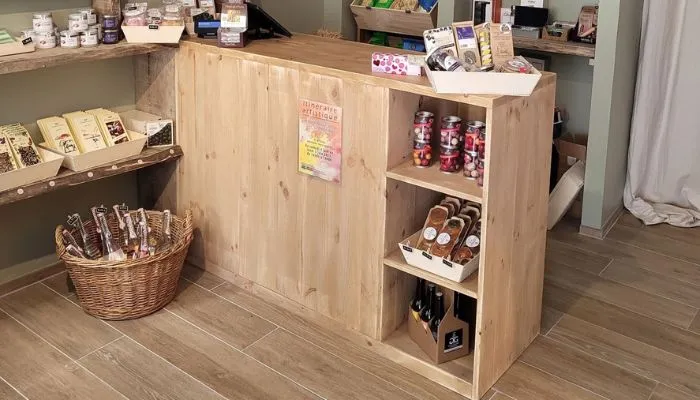
Wooden shop counter: The right choice for bakeries, cafés, delis, and artisan food retailers where the aesthetic contributes directly to the brand. A wooden finish reads as warm, handcrafted, and considered.
How to choose a shop counter for a convenience store
A convenience store needs a display counter for shop use that handles high daily transaction volumes, integrates a cigarette gantry or under-counter tobacco storage, and leaves enough worktop for a card terminal, receipt printer, and bagging area simultaneously. A standard flat counter from 1000mm to 1600mm wide covers the majority of UK convenience store checkouts. Shops with two staff operating simultaneously need 1600mm minimum. For the full range of shop counter for sale UK options, browse dynamicshelf.co.uk/collections/shop-counters.
What the price difference actually means
This is the part of the buying decision most retailers get wrong. A flatpack joinery counter at £200 and a commercial retail till counter UK convenience stores operate at volume, like Dynamic Shelf’s metal-framed counter at £425, are not the same product at different price points. They are different products serving different purposes.
A flatpack joinery counter is handmade from MDF or timber and designed for lower-traffic environments where aesthetics matter more than structural durability. It looks excellent in a boutique or gift shop. In a convenience store handling hundreds of transactions a day, it shows wear within the first year: swollen panels from moisture near drinks fridges, chipped edges from basket contact, instability from repeated leaning.
A commercial metal-framed counter with a 38mm solid worktop is built for the structural demands of a working retail checkout. The frame does not flex under repeated load. The worktop handles daily commercial cleaning without deteriorating. It costs more to buy and significantly less to own over a three to five year trading period.
The practical question is not which counter is cheapest. It is which counter will still look and function well in three years of daily use at the volume your specific shop operates at.
Sizing: The most common mistakes
Too narrow for the transaction volume: A minimum width of 1000mm gives one staff member a functional workspace. A store that regularly has two staff at the till simultaneously needs 1600mm or wider.
Too short for the range of products being scanned: Bulky items, multipacks, large bottles, bagged produce, need space to be placed, scanned, and moved without disrupting the flow of the next transaction.
Not accounting for counter depth in the floor plan: Plan for at least 900mm of clear staff aisle behind the counter and measure that space before ordering.
Choosing a counter that cannot grow with the business: Dynamic Shelf counters are modular, so standard bays connect as the checkout area grows. Buying a fixed-width counter means replacing it entirely when the shop expands.
Pairing the counter with the right accessories
The counter does not operate in isolation. Three accessories significantly improve checkout efficiency in a UK convenience store.
A cigarette gantry, either under-counter or wall-mounted behind the checkout, keeps tobacco products secure, organised, and accessible without requiring staff to leave the till position.
EPOS data strips on the customer-facing shelves keep impulse-purchase products labelled and priced without the counter looking cluttered.
Shopping baskets at the entrance and a basket-drop position at the counter create a complete customer flow from entry to checkout without interruption.
All three are available from Dynamic Shelf alongside the full counter range, so the entire checkout area can be specified from a single supplier with consistent dimensions and finishes.