


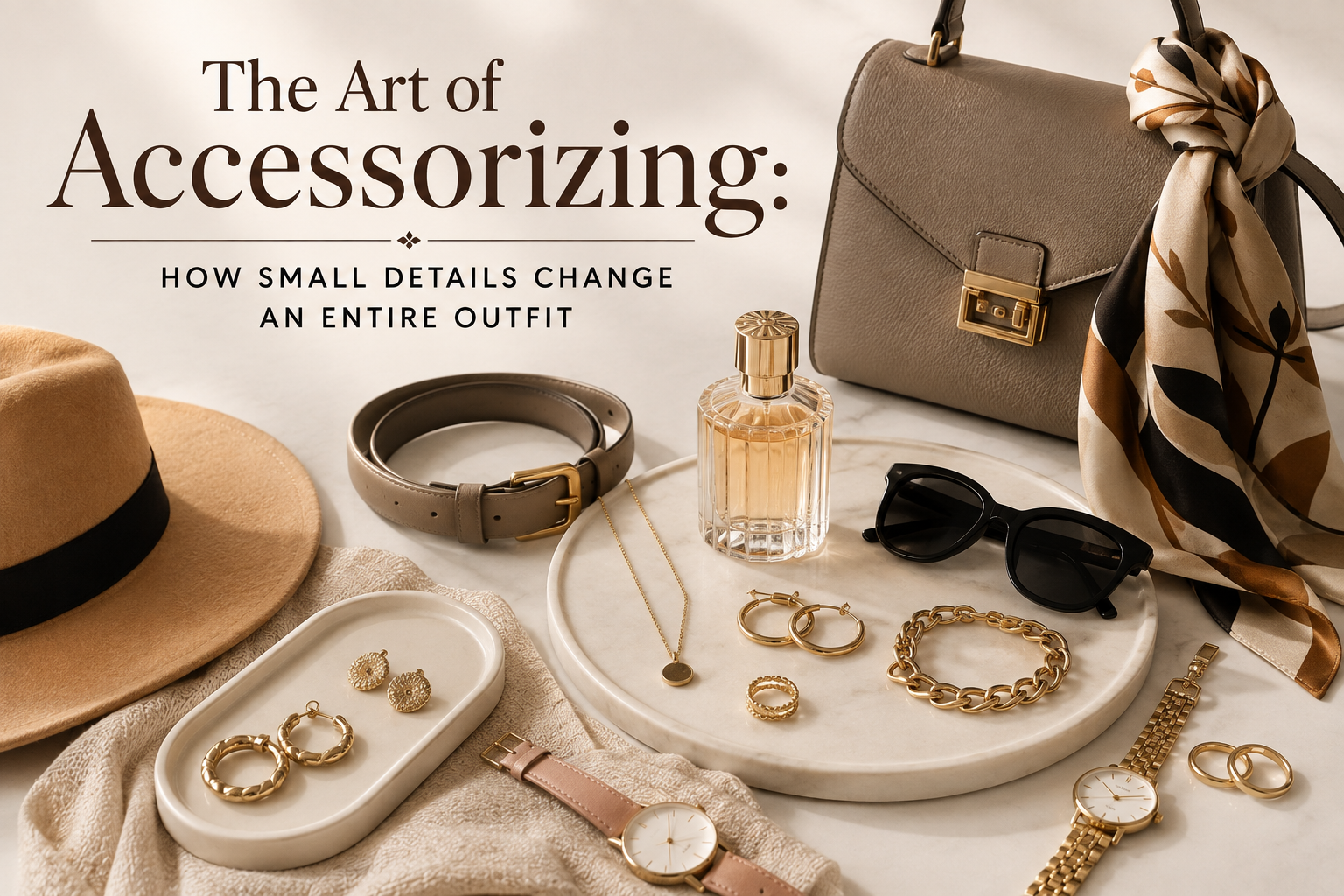
Accessories are often the last thing added to an outfit and the first thing overlooked when people think about improving their personal style, yet they tend to do more work than almost any other styling decision. The right accessory can turn a simple, basic outfit into something that looks intentional and put-together, while the wrong choice — or no choice at all — can leave even a well-fitted outfit feeling unfinished.
This guide breaks down how to think about accessorizing as a practical skill rather than an afterthought, covering the principles that make the difference between an outfit that looks “fine” and one that looks genuinely styled.
Why Accessories Matter More Than People Think
Clothing sets the foundation of an outfit, but accessories are what give it personality, polish, and context. Two people wearing the exact same basic outfit — a t-shirt and jeans, for example — can look completely different depending on what they’ve added: one with minimal jewelry and sneakers reads casual and relaxed, while the other with a statement necklace, a structured bag, and heeled boots reads elevated and intentional.
This is precisely why accessories are one of the most efficient tools in a wardrobe. Rather than needing an entirely new outfit for every occasion, a well-chosen set of accessories can shift the same base pieces across a wide range of settings and moods.
Start With Proportion and Balance
Before thinking about specific pieces, it helps to consider the overall proportion of an outfit. A very busy or detailed outfit — patterns, textures, layers — generally pairs better with simpler, more minimal accessories, since too many competing elements can make an outfit feel chaotic rather than intentional. Conversely, a simple, monochromatic outfit has more room for a bolder accessory to take center stage without overwhelming the look.
A useful mental check: if an outfit already has several visually busy elements, let accessories play a supporting role. If the outfit is pared-back and simple, that’s the moment to let one accessory shine.
The One-Statement-Piece Rule
A common mistake is treating every accessory as an opportunity to make a statement, which often results in outfits that feel cluttered rather than polished. A more reliable approach is choosing one true statement piece per outfit — a bold necklace, an eye-catching bag, a standout pair of earrings — and letting everything else stay quieter in support of it.
This doesn’t mean minimalism is the only path. It simply means that when multiple loud elements compete for attention at once, none of them get to shine individually, and the overall look reads as busy rather than curated.
Building a Versatile Accessory Collection
Just as a capsule wardrobe relies on versatile clothing pieces, a strong accessory collection benefits from a similar approach. A handful of well-chosen, versatile pieces will get more consistent use — and more compliments — than a large collection of trend-specific items that only work with one outfit.
A practical starting set that covers most situations:
- A few pairs of everyday earrings in different scales, from subtle studs to a slightly bolder hoop or drop style
- One or two necklaces that layer well or stand alone, in a metal tone that matches most of your wardrobe
- A structured bag in a neutral color that works for both daytime and slightly dressed-up occasions
- A casual, everyday bag for errands and relaxed outings
- A belt that can define the waist on looser silhouettes or add polish to simple outfits
- One statement piece — a bold necklace, an eye-catching scarf, or standout earrings — reserved for when you want an outfit to feel a little more elevated
Building around a consistent metal tone (gold, silver, or mixed intentionally) and a few neutral bag colors makes it far easier for new pieces to work with what you already own, rather than existing as isolated, hard-to-match items.
If you want to read more fashion Related article Visit: STYLE BLOOMING
Using Accessories to Shift an Outfit’s Formality
One of the most useful accessorizing skills is knowing how to move the same outfit up or down in formality just by changing what’s added to it. This is especially valuable for anyone juggling multiple settings in a single day, or packing light for travel.
- To dress an outfit up: add a structured bag, a heeled shoe, and slightly more refined jewelry.
- To dress an outfit down: swap to a crossbody or tote bag, flats or sneakers, and minimal jewelry.
- To add warmth or texture: a scarf, a textured belt, or layered bracelets can shift an outfit’s overall feel without changing the clothing itself.
Thinking of accessories as adjustable variables, rather than fixed pairings, makes it possible to get significantly more mileage out of a smaller wardrobe.
Accessorizing for Different Necklines and Silhouettes
Jewelry in particular tends to look most intentional when it’s chosen with the outfit’s neckline and silhouette in mind, rather than picked at random. A higher neckline generally pairs well with statement earrings or a shorter necklace that sits visibly above the fabric line, while a lower or open neckline often has more room for a longer pendant or layered necklaces to stand out.
For outfits with a lot of visual detail near the neckline — a patterned collar, a high-detail top — simpler jewelry usually reads better, letting the outfit’s existing detail take the lead instead of competing with additional pieces.
Common Accessorizing Mistakes
A few patterns come up repeatedly when accessories don’t quite land, even with otherwise well put-together outfits:
- Over-accessorizing every outfit equally. Not every look needs a full set of jewelry, a bag, a scarf, and a belt all at once — sometimes restraint reads as more polished.
- Ignoring proportion. Delicate jewelry can get visually lost against a heavily patterned or textured outfit, just as an oversized accessory can overwhelm a simple, minimal look.
- Mismatched metal tones. Mixing metals can work intentionally, but unintentional mismatches often read as simply uncoordinated.
- Choosing bags purely on trend. A trendy bag that doesn’t match your usual color palette often ends up underused compared to a versatile, neutral option.
Frequently Asked Questions
How many accessories should I wear at once? There’s no fixed number, but a helpful guideline is one true statement piece paired with a few quieter supporting elements, rather than several bold pieces competing for attention.
Is it okay to mix gold and silver jewelry? Yes, when done intentionally — mixed metals can look modern and put-together. The key is consistency across an outfit rather than random, unplanned mixing.
What’s the single most versatile accessory to invest in? A structured, neutral-colored bag tends to offer the most versatility, since it works across casual and dressed-up outfits alike and rarely goes out of style.
How do I know if an accessory is “too much” for an outfit? If an outfit already feels visually busy from patterns, textures, or layering, that’s usually a sign to keep accessories minimal rather than adding another bold element on top.
Final Thought
Accessories are one of the most effective, low-effort tools for changing how an outfit looks and feels, without needing to buy new clothing. A thoughtful, versatile accessory collection — paired with an understanding of proportion, formality, and balance — does far more for a wardrobe than chasing every new trend piece.
For a deeper breakdown of accessory pairings and styling by occasion, Style Blooming’s complete accessories guide covers jewelry, bags, and finishing touches suited to a range of outfits and settings.